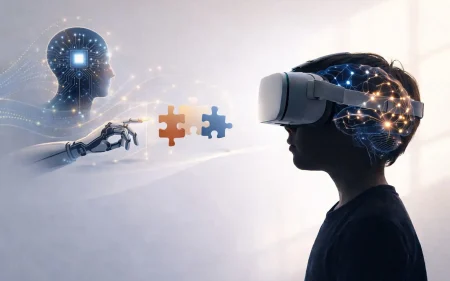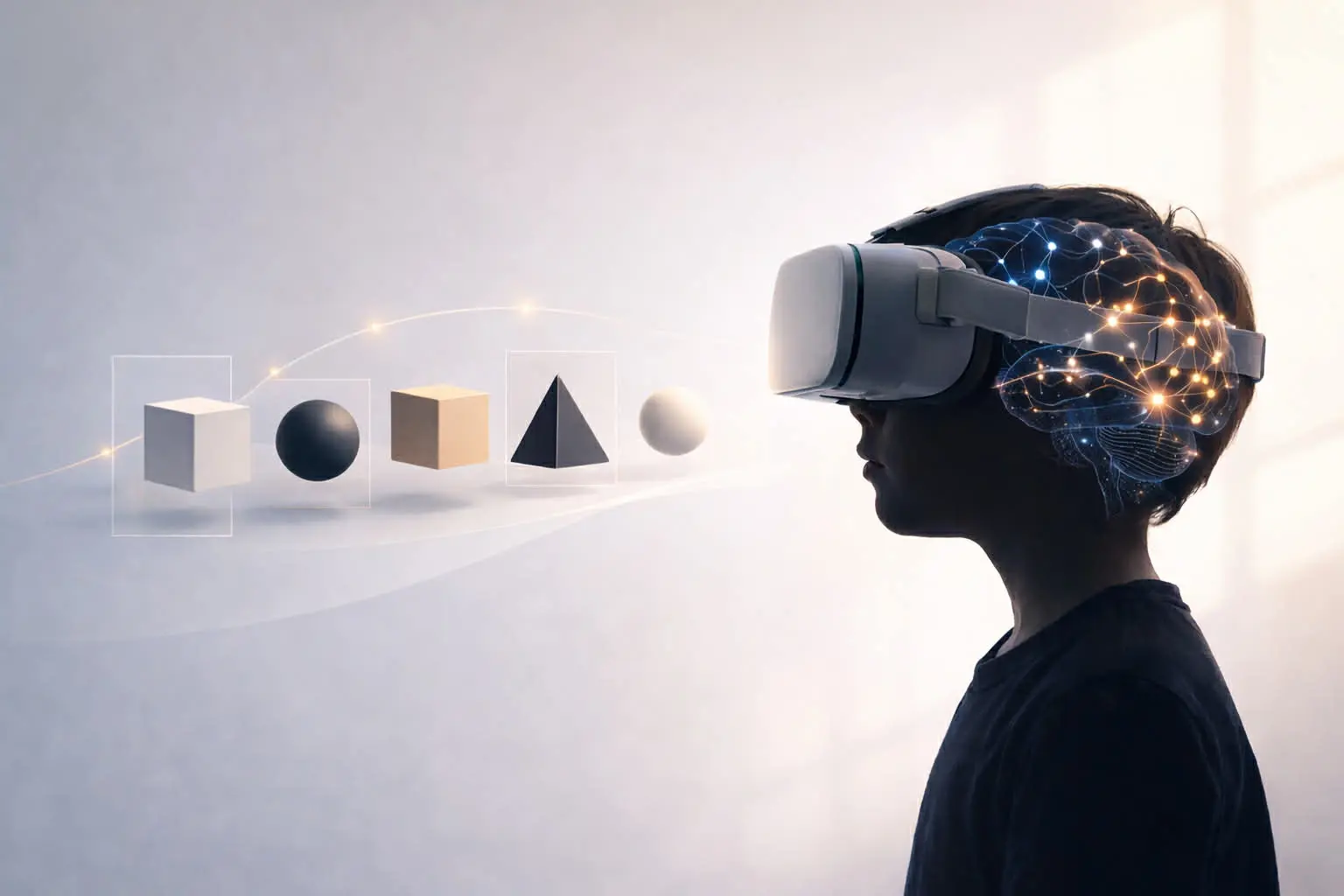

In recent years, technology has begun to play an increasingly meaningful role in the fields of psychology and education. Among the most promising innovations is Virtual Reality (VR), a tool that is no longer limited to entertainment but is now being actively explored for therapeutic and educational purposes. In the context of Autism Spectrum Disorder (ASD), researchers have shown growing interest in how immersive virtual environments can support the development of executive functions.
Executive functions refer to a set of cognitive processes that allow individuals to regulate their behavior, plan ahead, control impulses, and adapt to changing situations. In simple terms, they are the mental skills that help us “think before we act.” These functions are essential for goal-directed behavior and play a critical role in everyday life, influencing everything from academic performance to social interaction and emotional regulation.
The development of executive functions begins early in life and continues through adolescence and, in some cases, into adulthood. However, this development is not linear. Different components—such as working memory, inhibitory control, and cognitive flexibility—mature at different rates, following distinct developmental trajectories.
Executive Functions in Autism
In individuals with Autism Spectrum Disorder, executive functions are often significantly affected. These difficulties extend beyond cognitive processing and have a direct impact on daily functioning, learning, and social interaction.
One of the most commonly observed challenges is reduced cognitive flexibility. Children with ASD may struggle to shift between tasks or adapt when routines change. This can manifest as rigidity in thinking and behavior, as well as difficulty coping with unexpected situations.
Problem-solving is another area where difficulties frequently arise. Planning, monitoring, and adjusting strategies require a high level of executive functioning, which may be limited in children with ASD. As a result, even relatively simple tasks can become challenging when they involve multiple steps or require adaptation.
Impulse control is also often impaired. The ability to inhibit automatic or immediate responses is essential for self-regulation and social behavior. When this ability is compromised, it can lead to impulsive actions and difficulties in social communication.
These challenges are closely linked to the functioning of the prefrontal cortex and can significantly influence a child’s independence and quality of life.
Virtual Reality as a Therapeutic Tool
Virtual Reality offers a unique opportunity to address these challenges in a structured and controlled way. By creating immersive, three-dimensional environments, VR allows users to engage in realistic scenarios while remaining in a safe and predictable setting.
For children with ASD, this is particularly valuable. It enables them to practice cognitive and social skills without the pressure and unpredictability of real-world interactions.
For example, a child can participate in a simulated classroom, interact with virtual characters, and practice responding to different social situations. These environments can be carefully designed to target specific executive functions, such as decision-making, attention control, and flexibility.
Unlike traditional interventions, VR provides a level of engagement that is often difficult to achieve through conventional methods. The interactive and immersive nature of the experience increases motivation and encourages active participation.
What Research Suggests
Current research indicates that VR-based interventions can lead to meaningful improvements in executive functioning among children with ASD.
Studies have shown that children who participate in virtual reality training programs demonstrate enhanced cognitive flexibility and improved ability to process contextual information. In addition, systematic reviews suggest that VR interventions can positively affect attention, learning capacity, and overall functional behavior.
Another important advantage is the ability of virtual environments to replicate established neuropsychological assessments in more realistic contexts. Tasks traditionally used to measure executive functions can be adapted into immersive simulations, providing a more ecologically valid way of evaluating performance.
Furthermore, VR allows for continuous monitoring and real-time adaptation of tasks based on the user’s performance. This makes it possible to create highly personalized interventions tailored to the needs of each individual.
Why Virtual Reality Works
The effectiveness of VR as an intervention tool can be attributed to several key factors.
First, it offers a controlled environment where variables can be carefully managed. This reduces anxiety and allows children to focus on the task at hand without external distractions.
Second, it enables repeated practice without fatigue. Skills can be rehearsed multiple times in a consistent manner, which is essential for learning and generalization.
Third, VR provides immediate feedback. This reinforces correct responses and helps shape behavior more effectively.
Finally, the engaging nature of virtual environments increases motivation. Many children perceive VR as a game-like experience, which enhances participation and persistence.
The Role of Behavioral Approaches
One of the most important aspects of VR-based interventions is their compatibility with principles derived from Applied Behavior Analysis (ABA).
Behavioral approaches rely on structured sequences involving stimulus, response, and reinforcement. These principles can be seamlessly integrated into virtual environments, where each action can be tracked and reinforced in real time.
This combination allows for interventions that are not only engaging but also systematic and measurable. It also supports the development of individualized programs that adapt to the progress and needs of each child.
Limitations and Challenges
Despite its potential, the use of virtual reality is not without challenges.
Practical considerations such as the cost of equipment, usability for younger children, and the need for technical support can limit accessibility. In addition, there are concerns regarding overstimulation and the long-term effects of extended VR use.
It is also important to note that VR should not be viewed as a replacement for traditional therapy. Instead, it should be considered a complementary tool that enhances existing intervention strategies.
Looking Ahead
The future of virtual reality in autism intervention is highly promising. Advances in technology are making VR systems more accessible, more adaptable, and more effective.
The development of specialized software targeting executive functions opens new possibilities for personalized therapy. These systems can incorporate structured tasks designed to improve cognitive flexibility, impulse control, and problem-solving skills.
As research continues to evolve, VR has the potential to become a central component of intervention programs, offering innovative and scalable solutions for individuals with ASD.
Conclusion
Enhancing executive functions in children with autism is a critical goal for both researchers and practitioners. Virtual Reality represents a powerful tool that can transform the way these skills are taught and developed.
While further research is needed to fully understand its long-term impact, current findings suggest that VR can significantly improve cognitive and behavioral outcomes.
When used thoughtfully and in combination with evidence-based practices, technology does not distance us from human interaction. On the contrary, it can help bridge gaps, support development, and create new opportunities for meaningful learning and growth.
References
Sideraki, A., Gena, A., & Anagnostopoulos, C.-N. (2025). Enhancing the executive functions of children and adolescents with Autism Spectrum Disorder using virtual reality. In Proceedings of the 2025 20th International Workshop on Semantic and Social Media Adaptation and Personalization (SMAP). https://doi.org/10.1109/SMAP66932.2025.00020
Baddeley, A. D., & Hitch, G. (1974). Working memory. In G. A. Bower (Ed.), The psychology of learning and motivation (Vol. 8, pp. 47–89). Academic Press.
Borgnis, F., Baglio, F., Pedroli, E., Rossetto, F., Uccellatore, L., Oliveira, J. A. G., Riva, G., & Cipresso, P. (2022). Available virtual reality-based tools for executive functions: A systematic review. Frontiers in Psychology, 13, 833136. https://doi.org/10.3389/fpsyg.2022.833136
Chung, K., & Chung, E. (2023). Randomized controlled pilot study of an app-based intervention for improving social skills, face perception, and eye gaze among youth with autism spectrum disorder. Frontiers in Psychiatry, 14, 1126290. https://doi.org/10.3389/fpsyt.2023.1126290
Diamond, A. (2013). Executive functions. Annual Review of Psychology, 64, 135–168. https://doi.org/10.1146/annurev-psych-113011-143750
Hill, E. L. (2004). Evaluating the theory of executive dysfunction in autism. Developmental Review, 24(2), 189–233. https://doi.org/10.1016/j.dr.2004.01.001
Shahmoradi, L., & Rezayi, S. (2022). Cognitive rehabilitation in people with autism spectrum disorder: A systematic review of emerging virtual reality-based approaches. Journal of NeuroEngineering and Rehabilitation, 19, 91. https://doi.org/10.1186/s12984-022-01062-2
Wang, M., & Reid, D. (2013). Using the virtual reality-cognitive rehabilitation approach to improve contextual processing in children with autism. The Scientific World Journal, 2013, 1–10. https://doi.org/10.1155/2013/209425
Williams, M. R., Alikhademi, K., & Gilbert, E. J. (2022). Design of a toolkit for real-time executive function assessment in virtual environments. International Journal of Human-Computer Studies, 158, 102734. https://doi.org/10.1016/j.ijhcs.2021.102734